
Appointment reminders in Libya: measure fewer no-shows
Appointment reminders can help customers remember a visit, but a reminder is only one part of an attendance process. A wrong phone number, an unclear location or a difficult cancellation process can still leave a slot unused. For a Libyan salon, clinic or training business, start with accurate booking details and a simple way to manage the appointment, then measure what changes.
Before you start
- Check the number and the booking details before blaming the message.
- Measure completed visits, no-shows and cancellations separately.
- Published reminder research supports a trial, not a guaranteed Numoo uplift.
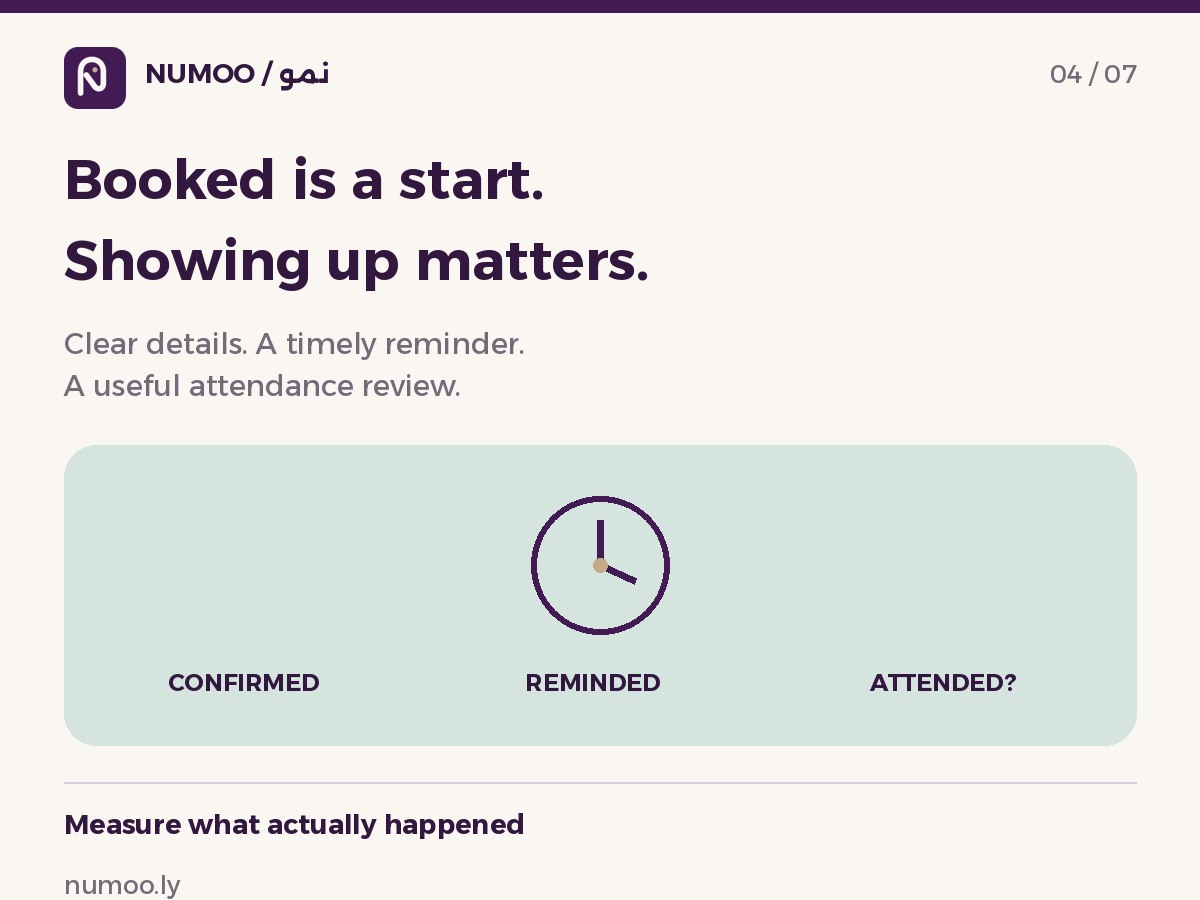
A reminder cannot fix an unclear appointment
Before thinking about message timing, read the booking as a customer would. Is the service name understandable? Is the date unambiguous? Does the customer know which location to visit and what they need to do if their plans change? The clearer the booking is at the start, the less work the reminder has to do later.
Ask reception to check contact details when taking a telephone booking. A number that looks plausible is not necessarily the customer’s current number. Avoid copying personal information into unrelated notes or sending test messages to people who have not agreed to a test. Use your own authorised test numbers to verify the process.
What research says about reminders
A 2013 Cochrane review included eight randomised trials with 6,615 participants. It found moderate-quality evidence that text reminders improved appointment attendance compared with no reminders. This is healthcare research from other settings, not a Libyan business benchmark or a test of Numoo.
The right business response is to run a measured pilot. A salon appointment, a hospital follow-up and a court rental have different reasons for cancellation or absence. Borrow the idea of testing reminders, not a universal improvement percentage. If customers report transport or price problems, another message may not solve the underlying issue.
How to describe Numoo’s reminder behaviour accurately
Numoo sends booking confirmations and has an automated reminder process around the day before eligible appointments. The process respects local sending hours and includes safeguards against redundant or very late reminders. A last-minute booking should not be described as guaranteed to receive an additional reminder at an exact minute.
Customers use their booking-management link to act within the business rules. Numoo’s currently approved message templates and sending behaviour are part of the service; this is not a claim that owners can build arbitrary marketing campaigns or customise any SMS wording. Keep promotional outreach separate from operational booking messages.
Define your no-show rate before the pilot
Choose an appointment-date period and wait until those visits could actually have happened. Do not include next month’s bookings in today’s attendance denominator. Decide how to treat cancellations, reschedules and appointments cancelled by the business, then keep the definition stable when comparing periods.
One practical measure is no-shows divided by completed visits plus no-shows. Track cancellations separately so a lower no-show rate does not hide a rise in last-minute cancellations. As an illustrative example, 10 no-shows and 90 completed visits give a 10% rate under this definition. Adding 20 future appointments would make the number look smaller without improving attendance.
| Record | Why it matters |
|---|---|
| Completed visit | The appointment was delivered. |
| No-show | The customer did not attend under your stated definition. |
| Cancellation | Track when it happened and whether the slot was refilled. |
| Reschedule | Follow the moved appointment; avoid counting the same visit twice. |
| Future appointment | Exclude from a completed attendance period. |
Look for the operational reason behind the number
Review missed appointments by service, day and booking lead time where your records allow. A pattern concentrated in one service needs a different response from a problem across every service. Ask a small, appropriate sample of customers what made attendance difficult, and record themes without exposing personal details in a public report.
Try one change at a time. Clarify a location, improve a service description or make the cancellation policy easier to find. Keep a dated note of the change. If you change prices, opening hours and reminders together, a better attendance rate will not tell you which action helped.
A weekly check your team can keep doing
Allocate a short review to the appointments that have finished. Confirm outcomes, look for message failures that need attention and identify late cancellations that left capacity unused. Then choose one improvement for the next period. A simple routine repeated consistently is more useful than a large report nobody maintains.
Keep results in proportion to the sample. A fall from two missed visits to one is not enough evidence for a sweeping marketing claim. Show the actual counts, the period and the service mix. When describing results outside the team, distinguish provider acceptance, handset receipt and attendance; they are three different stages.
Common questions
Does an accepted SMS prove the customer received it?
No. Provider acceptance confirms a gateway step. It does not prove handset receipt, reading or attendance. Use authorised delivery tests to check receipt and review actual booking outcomes to measure the operational result.
Can reminders guarantee that customers attend?
No. People may change plans or face problems a reminder cannot resolve. Accurate details, an understandable cancellation process and reliable reception practices matter too. Measure a pilot using comparable appointment periods rather than promising a fixed reduction.
Are reminder messages the same as promotional SMS?
No. A booking reminder relates to an appointment. Promotional campaigns have a different purpose and should not be assumed to be available or authorised just because a phone number was supplied for a booking. This guide concerns operational appointment messages.
Put it into practice
This guide describes current product behaviour. Worked examples are illustrative, not customer results or performance guarantees.
Open the illustrated steps in the product guideMake the next step a practical one.
Set up one service and a clear schedule, then start with your business link.
Start your business page