
A weekly booking review that leads to one useful decision
A weekly booking review should end with a decision someone owns. Start by separating appointments that already happened from bookings created during the week and appointments still to come. Then check attendance, cancellations, customer history and saved booking value. This guide gives a Libyan business owner a repeatable review routine that can be used with Numoo records and a simple decision log.
Before you start
- A booking’s creation date and appointment date answer different questions.
- Customer records represent a relationship with a business, not a ready-made marketing list.
- Choose one action, one owner and one review date.
Choose the question before the date filter
“How much demand came in this week?” is a creation-date question. “What happened in the appointments we were due to deliver?” is an appointment-date question. “What is reception preparing for?” is an upcoming-bookings question. Mixing them produces a report that looks precise but cannot support a clear decision.
Numoo keeps creation and appointment information. The platform founder dashboard separates these views, while business owners should use the available business reports and booking records for their own activity. A founder’s cross-business view is not access granted to ordinary business owners. Keep the reporting scope clear when sharing screenshots or totals.
Check outcomes before interpreting booking value
Review completed appointments, cancellations and no-shows, then look at their distribution by service. Make sure staff have finished updating the statuses for the period. A booking left in an old state can distort the story more than a sophisticated chart can repair. Flag uncertain records for follow-up instead of quietly counting them as successes.
Saved booking value describes the agreed price recorded with a reservation. It may reflect an offer and selected extras. It is not the same as cash collected or profit. Reconcile actual payments through the business’s payment records, and keep variable costs separate if you are evaluating an offer or an additional service.
Use customer history to improve the next visit
A customer record can help reception recognise a returning person and find their previous bookings. Check that the name and phone number are accurate enough for the operational job. A phone number is not a perfect universal identity: people can share numbers or change them. Avoid merging people or drawing personal conclusions from a number alone.
Use access appropriate to each person’s role and avoid exporting more information than the task needs. Do not post customer names, numbers or appointment details in a public marketing example. Keep demonstration data separate. A contact provided for a booking should not be treated as automatic permission for unrelated promotional outreach.
Find the decision hidden inside a pattern
If one service attracts bookings but also repeated cancellations, check its description, price and practical requirements. If a staff member has an uneven workload, look at availability and the services assigned before assuming customer preference. If returning customers are rare in a short period, consider the natural interval between visits before declaring a retention problem.
Use small counts carefully. Three cancellations in a week of ten appointments and three in a week of one hundred have different meaning. Show numerator and denominator, the period and any change in opening hours. Compare similar periods and record obvious disruptions so the team can challenge the interpretation.
| Observed pattern | First question | Possible next action |
|---|---|---|
| Repeated service questions | Is the description clear? | Rewrite one service description. |
| Late cancellations | Were rules and location understood? | Clarify the relevant information. |
| Unused availability | Was capacity actually offered? | Review the published schedule. |
| High booked value, low collections | Did visits happen and payments arrive? | Reconcile outcomes and payment records. |
Use a decision log, not a list of impressions
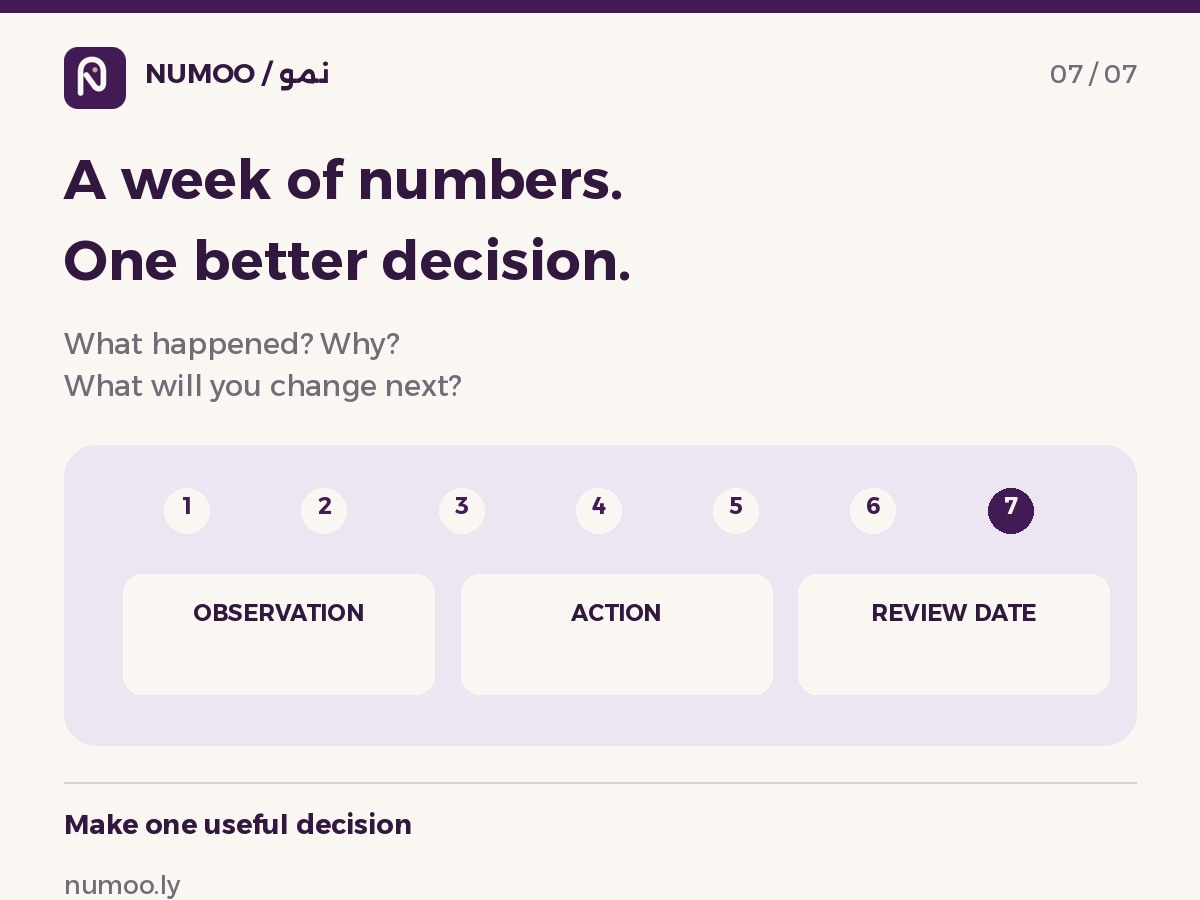
Write the observation, the evidence and one proposed action. Assign a person and a review date. For example: “Five customers asked whether the extra was included; reception will clarify the description before the next post; review the next twenty bookings.” That is an illustrative working note, not a claim about a Numoo customer.
Keep the earlier wording or setting so you can understand what changed. Do not turn a weekly review into a pile of simultaneous experiments. If the team changes opening hours, prices and the booking description together, it will be harder to tell which change mattered. Prefer a small, explainable improvement.
- Observation: what happened, with counts and dates?
- Interpretation: what might explain it, and what is still unknown?
- Action: what single change will be made?
- Owner: who will do it?
- Review: when and with which measure will you check it?
Prepare the coming week before closing the review
Look at upcoming appointments with the people who will deliver them. Check staff availability, service durations and any known closure. Identify bookings that require an operational follow-up and handle them through the normal business process. The purpose is preparation, not contacting every customer unnecessarily.
Close with the one action you chose and the date you will return to it. Over time, this creates a record of decisions and results rather than a folder of screenshots. Numoo’s records can make the review easier, but the useful outcome is still a practical change that your team understands and can carry out.
Common questions
Why does the overview count differ from all bookings?
The overview may use a selected creation-date period, while an all-bookings view includes history outside that range. Upcoming appointments answer another question. Check the date basis and filters before treating different totals as a data error.
Does a returning customer count prove loyalty?
It shows repeat booking activity under the report’s definition. It does not prove satisfaction, future attendance or long-term loyalty. Consider completed outcomes, the normal interval between visits and the length of the observation period.
Should I export all customer phone numbers every week?
Only export what a defined task needs, restrict access and keep the file private. Most routine reviews can use aggregate figures and targeted record checks. A larger spreadsheet is not automatically a better decision tool.
Put it into practice
This guide describes current product behaviour. Worked examples are illustrative, not customer results or performance guarantees.
Open the illustrated steps in the product guideMake the next step a practical one.
Set up one service and a clear schedule, then start with your business link.
Start your business page